

Transparency
Transparency Matters in Local Government
Transparency is the foundation of public trust in local government. City councils make decisions that directly affect residents’ taxes, neighborhoods, schools, and quality of life. When those decisions are made openly, with clear rules and accountability, residents can have confidence that their government is acting in the public interest, not for personal or political gain.
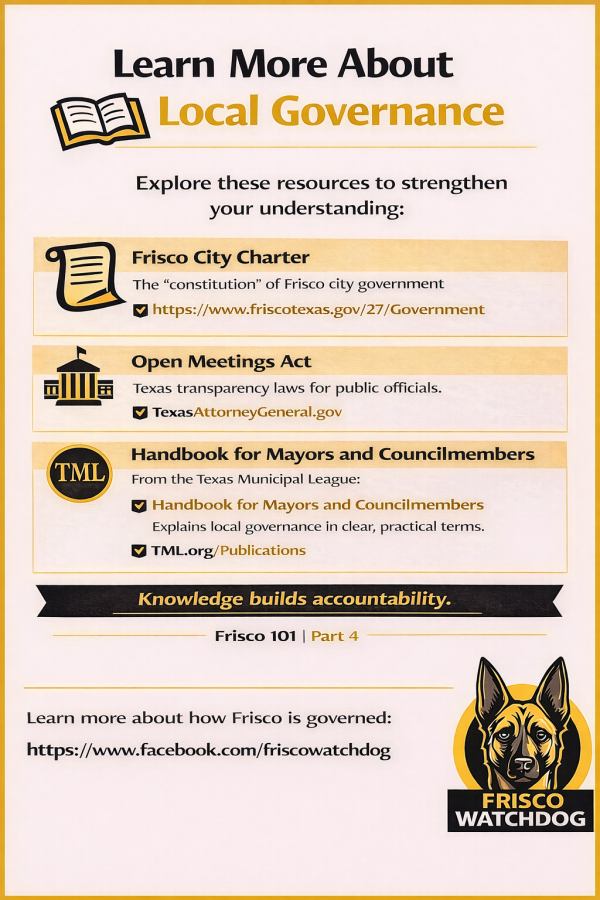
In Texas, transparency is not just a best practice; it is the law. The Texas Open Meetings Act, along with local governing documents such as the City of Frisco Charter and the City of Frisco Code of Conduct, establish clear expectations for openness, ethical behavior, and accountability.
Transparency Builds Trust and Legitimacy
Local governments operate closest to the people. Unlike state or federal institutions, city councils are highly visible and accessible. We may see more news about the state or federal government, but as citizens we have far more opportunity to interact with our City Council and Board of Trustees than we do with the others.
Transparency helps ensure that:
- Residents understand how and why decisions are made
- Elected officials are accountable for their votes and actions
- Public confidence is maintained, even when decisions are controversial
- Rumors, misinformation, and perceptions of favoritism are reduced
When meetings are open, agendas are clear, and discussions occur in public view, residents are better equipped to engage meaningfully in civic life. Understand that some agenda items require specific language. From personal experience, I recall a couple of state mandated items that actually caused confusion when they were on the agenda because of the way they had to be worded. It’s an imperfect system for sure, but whenever possible, the goal is to be as clear and precise as possible
The Texas Open Meetings Act: Open Government by Law
Chapter 551 of the Texas Government Code
The Texas Open Meetings Act (TOMA) is one of the strongest transparency laws in the country. Its purpose is straightforward: the public’s business must be conducted in public.
Under TOMA:
- Meetings of a quorum of a governmental body must be posted in advance
- Agendas must clearly describe the topics to be discussed or acted upon
- Deliberations and decisions must generally occur in open session
- Private discussions among council members intended to avoid public scrutiny are prohibited. This is sometimes referred to as “Walking Quorums,” or situations in which one or more members may attempt to make a decision on a subject by talking individually, rather than as a body, and still reach a decisions. I may do an entire post on walking quorums.
TOMA exists to prevent decisions from being made behind closed doors and later ratified in public without meaningful open discussion. For residents, TOMA ensures that they can observe the decision-making process, not just the final vote.
The “Social Interaction” Exception — What It Is and What It Is Not
It’s important to understand that city council members are human beings, not hermits. They live in the community, attend public events, and sometimes find themselves in the same room together outside of City Hall. The Texas Open Meetings Act recognizes that and includes a limited exception for social gatherings. I’ll discuss other exceptions and executive sessions later in this post.
Under the Open Meetings Act, a gathering of council members is not considered a “meeting” if:
- The event is purely social, such as a holiday party, ribbon cutting, charity fundraiser, or civic event, and
- No city business is discussed, and
- No deliberation occurs on any matter that could come before the council.
In other words, council members may attend the same social function as long as the conversation does not drift into city business.
Examples of generally permissible situations:
- Attending a Frisco Chamber of Commerce event
- Being present together at a school function or community celebration
- Participating in ceremonial events like groundbreakings or dedications
Simply being in the same place at the same time does not violate the law. It’s sad to say but I have had someone secretly photograph me while at dinner with my wife and a former colleague and their spouse and post it online questioning what we were discussing. Folks. We were at dinner, we were discussing our kids, work, and families. There’s nothing wrong with that. What is a problem is people secretly taking photographs in an attempt to vilify people. That is not OK. It’s a violation of privacy, and no one should stand for or accept those actions. Elected officials are entitled to a level of privacy.
Transparency in the City of Frisco Charter and Code of Conduct
The City of Frisco Charter Section 3.11 and Code of Conduct reinforce these principles at the local level. Together, they outline the ethical responsibilities of council members and establish expectations for integrity, accountability, and professionalism.
These documents ensure Council Members are:
- Acting in the best interest of the entire community
- Avoiding both actual conflicts of interest and the appearance of impropriety
- Conducting city business openly and respectfully
- Maintaining public trust through ethical decision-making
These local rules recognize that transparency is not only about following the law, but also about upholding public confidence in city leadership.
According to Section 3.09 of the Charter [LINK]:
- Except as provided by state law, all City Council meetings shall be open to the public and shall be held and notice given in accordance with the Texas Open Meetings Act.
This means silence is not an option — the Charter explicitly ties city meetings to the state’s open meetings requirements, ensuring public access to discussions and decisions.
You can view the full Charter online at the City of Frisco’s official site here:
City of Frisco Charter / Agendas & Meetings — Friscotexas.gov
Ethical Conduct and Conflicts of Interest
The Frisco Charter also addresses conflicts of interest directly.
Section 3.11 states that if a council member has a conflict of interest with an agenda item, they must:
- Openly declare that conflict before discussion begins,
- Not participate in the discussion or vote on that item,
- And they are not counted toward the quorum for that specific vote.
This rule isn’t just legal housekeeping, it’s a trust-builder. When a council member steps aside from a vote where they might benefit personally, it protects the integrity of the council’s decision and ensures the process is fair and focused on the public good.
Why Recusal for Conflicts of Interest Is Critical
One of the most important transparency tools available to council members is recusal.
A conflict of interest arises when a council member has a personal, financial, or professional interest that could reasonably influence, or appear to influence, their judgment on a particular matter. Even if no improper intent exists, the appearance of a conflict can damage public trust.
Let’s be open. Conflicts will happen. It’s a simple fact. There is nothing inherently wrong with that as long as the appropriate recusal process is followed.
Recusal matters because it:
- Protects the integrity of council decisions
- Shields the city from legal challenges
- Reinforces ethical standards set by state law and local policy
- Preserves public confidence in fair and impartial governance
By disclosing conflicts and stepping away from discussion and voting when appropriate, council members demonstrate that the public interest comes first
One item that comes up frequently is campaign donations. By law, legal donations to a campaign do not constitute a conflict. It’s certainly up to the public to review and determine how they feel about any given donation, but they do not create a legal conflict that requires recusal.
When Closed or Executive Sessions Are Appropriate
While transparency is the default, Texas law recognizes that certain limited matters must be discussed privately to protect the city’s legal or financial interests. The Texas Open Meetings Act allows for closed (executive) sessions only in specific, narrowly defined circumstances.
Common examples include:
- Consultation with the City Attorney for legal advice where public discussion could waive privilege.
- Real estate negotiations (purchase, exchange, lease, value) where public knowledge could harm the city’s negotiating position.
- Economic development discussions involving financial incentives for business prospects.
- Personnel matters, such as performance evaluations or appointments, where confidentiality is appropriate.
Even in these cases, important safeguards remain in place:
- The topic of the executive session must be posted on the agenda
- Discussion must stay strictly within the permitted subject matter
- Any final action or vote must occur in open session
Executive sessions are not loopholes for secrecy. They are limited tools designed to protect the public interest when openness would cause harm. In Frisco’s stage of development, we may see more of these items for a while than the average city. This is because we are at a stage where we are attracting commercial development and businesses, and those will inherently have more discussions that will involve negotiations.
Here’s the critical point: no final action or vote may be taken in closed session. All decisions must occur in open session where the public can hear them.
Bottom line… executive session exists to protect the public interest, not elected egos. Violating the confidentiality of executive session is not a technical misstep; it is a breach of duty. The law grants elected officials access to sensitive discussions precisely because it expects restraint, discipline, and respect for the public trust. When a council member discloses what was said behind closed doors, they place personal agendas above the city’s legal and ethical obligations. Breaches of this trust can expose the city to lawsuits, damage negotiations, and chill honest dialogue among officials, ultimately harming taxpayers. Just as troubling, violations erode public confidence by signaling that rules apply selectively. If officials cannot honor the most fundamental rules of office, they forfeit the credibility required to lead. Transparency matters, but so does respecting the boundaries the law establishes to ensure responsible, effective governance.
Transparency Is an Ongoing Commitment
Transparency is not achieved simply by complying with minimum legal requirements. It requires sustained commitment by elected officials to openness, ethical conduct, and respect for the public they serve.
When council members follow the Texas Open Meetings Act, adhere to the Frisco Charter and Code of Conduct, recuse themselves when conflicts arise, and use executive sessions appropriately, they reinforce the principle that government exists to serve the people, not the other way around.
In local government, transparency isn’t just good policy. It’s the cornerstone of democracy at the community level.