

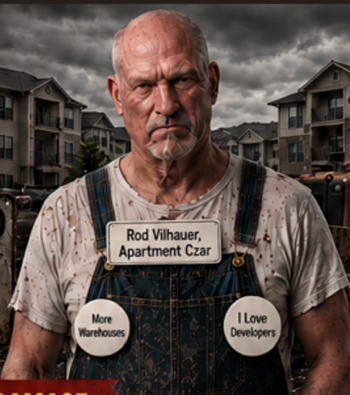
Rod Vilhauer is not a fresh face with new ideas. He is the “Density King” with a paper trail of failed zoning cases that lined his pockets while creating the worst planning era in Frisco’s history. Now he wants to run the whole city, while his conflicts of interest are bigger than ever.
As a former Planning & Zoning (P&Z) Commissioner and City Council member, I did my homework on Rod Vilhauer’s policies. He was a P&Z commissioner from 1991-1998, and I was genuinely shocked by what I found in meeting minutes. I am not speculating about what Rod Vilhauer might do as Mayor of Frisco. I read his record.
It shows a consistent, documented pattern of self service, not public service.
Here’s the short version:
- Rod Vilhauer was absent 35% of the time when Frisco needed him most.
- He approved 55,370 potential apartment units while Frisco had fewer than 1,400, becoming the “Density King.”
- He allowed industrial zoning to occupy the city’s most valuable corridors, areas we are still trying to reclaim.
- He used his public seat as a private business development tool.
- He failed to recuse himself from cases where he may have had financial interests.
- He protected his own neighborhood while making it impossible for others to protect theirs.
- Rod’s legacy is the apartment and warehouse zoning phase of Frisco’s history.
Fast forward to 2026, with a real estate agent wife and old developer allies circling the board, this same Density King wants to be the Frisco Mayor.
Voters deserve to know the truth about Rod Vilhauer’s failed policies, his conflicts of interests, and his zoning for dollars. Frisco simply can’t afford to have Rod Vilhauer in any city leadership position, especially as the Mayor.
1. The Density King’s Record: The Worst P&Z Era in Frisco History
Rod Vilhauer wants to be Frisco Mayor, but voters need to know that he is a primary architect of what our municipal records suggest was the WORST Planning & Zoning era in Frisco history. Frisco today is known as an example of suburban success, but our current quality of life exists in spite of a “Wild West” era with reckless policies by Rod that almost choked out our entire future.
In the early 1990s, while the foundations of our community were being poured, we had the opportunity to create a city that did not have industrial zoning, warehouse zoning next to residential, or reckless density due to “zoning for dollars.” Poor zoning decisions are generational anchors that drag down property values, create issues for future city planning, and invite crime. Rod was squarely behind these poor decisions that needed to be corrected for decades after. Before the city had the professional planning safeguards it enjoys today, Rod Vilhauer was busy stacking and packing Frisco for his own business and profit as well as the benefit of developers, leaving today’s taxpayers to foot the bill for thirty years of damage control.
Bottom Line: Frisco leadership has spent nearly 30 years trying to correct the massive issues caused by Rod’s failed zoning policies from the 1990’s, and the work is still not done.
2. The “Apartment Czar” and the High-Density Explosion
Rod is not only the Density King, he is the Apartment Czar.
From 1991 to 1998, Frisco underwent a “stack and pack” phase that nearly destroyed its suburban appeal. Vilhauer, acting as the “Apartment Czar,” presided over a record-breaking spree of garden-style apartment approvals that ignored public outcry. The scale of this negligence was finally exposed on April 14, 1999, when newly hired planning director John Lettellier sounded the alarm. Lettellier revealed that while Frisco only had 1,395 existing apartments, the zoning approved during the Vilhauer era had created a “potential build out of 55,370” units. This triggered a city-wide panic, but the “Apartment Czar” had already done the damage.
Read that again. 1,395 existing. 55,370 garden style units approved by Rod. No doubt, he is the Frisco Apartment Czar!
Notable apartment approvals on Rod’s watch include:
- Stonebrook Village: Sub-standard garden-style apartments that even the owner later admitted were a “worst crime problem” for the city.
- North Court Villas: The catalyst for Frisco’s infamous and costly legal battle regarding Section 8 housing.
- Independence and 121: A project Vilhauer pushed through despite a staggering protest from nearly 800 residents.
- Massive Density Hits: Including 646 units at Main and Preston, 500 units at Chapel Creek, and 510 units at Vintage at Legacy.
Bottom Line: Don’t want more apartments in Frisco? Blame Rod Vilhauer, the Apartment Czar, who approved almost all of them!
3. “Warehouse Rod”: Zoning Frisco into an Industrial Corner
Rod is apparently out there telling the folks who recently protested warehouses at a city council meeting that he would help them fight City Hall on the warehouse zoning.
Wow. Do they realize that Rod Vilhauer is the same “Warehouse Rod” who actually APPROVED that same tract of land for warehouse zoning back in the 1990’s? Is he planning to fight himself and his failed policies?
According to meeting minutes, Rod consistently prioritized industrial and self-storage projects on land that should have been high-value developments. In fact, he treated the Rail District and major corridors like a dumping ground for industrial with zero vision or foresight:
- Rail District Blight: Don’t like the industrial zoning in the Rail District? Rod approved the industrial zoning at 5th and Hickory and 5th and Elm, areas the city is still struggling to redevelop today.
- The AT&T Building: Rod approved the massive utility building to occupy two blocks of 5th and Elm, some of the most valuable land in the Rail District.
- Industrial Encroachment: He approved warehouses at Taft Powell, Main and Teel, and more on Main Street, along with a mini-warehouse at 121 and Warren that effectively killed any further development in that area. Yep, that’s Warehouse Rod.
- The Brookshires Failure: The development at Main and Preston stands as a monument to his era: no development standards, no open space, and now one of the worst corners in the city.
- Batch Plant: Perhaps Rod’s greatest failure was a missed opportunity in the city core. He had an opportunity to move the batch plant out of downtown. Instead, he approved their permit.
Apparently, Rod Vilhauer never saw a warehouse or self storage facility he did not love, including the one Richwoods residents are upset about.
Bottom Line: Don’t like the warehouse zoning next to residential? Blame Warehouse Rod for APPROVING them in the 1990’s!
4. Zoning for Dollars: The Conflict of Interest Question
Here is where this stops being about the past and starts being about right now.
Rod Vilhauer must answer for an era of “zoning for dollars,” where he granted density to inflate land value for developers. The record suggests his P&Z seat served as a lead generation tool for residential development business. Vilhauer had a habit of being the one to “make the motion” or “make a second” during residential cases. It was basically a “Make a Motion Business Card” tactic used to curry favor with the developers who would later hire him.
Let’s talk about conflict of interest. Rod recused himself at least 10 times for conflicts of interest; that’s a massive red flag. And specifically regarding Centex Homes in Plantation Resort, he failed to recuse himself for subsequent Centex items which he should have, if the original conflict existed.
According to meeting minutes, Rod may have leveraged his position on the P&Z to pocket profit for his own personal construction business, voting for reduced setbacks and increased density at every turn. He certainly had the ability to solicit business based on his knowledge of these developments coming to Frisco. Ultimately he worked on many of these developments. In today’s world he may state he wants to get rid of specific religions, but he clearly knows that would be illegal as he was involved in several church zonings while on P&Z. Why is he lying to the public about what he can do? This is nothing other than race baiting rhetoric in his campaign.
Rod also served closely with Baxter Brinkmann on P&Z. What will happen if Brinkmann, who is known for maximizing entitlements and reducing quality, brings Brinkmann Ranch to a zoning decision with Rod as Mayor? This should be a concern to all citizen, but especially if you live on the east side of town. You want more development like the west side, but Rod is not known for that, expect the worst.
Rod also approved many Wade/Newman entitlements back in the day, so they may support Rod for Mayor and have an expectation of support for the future. This begs the question of all of these long standing development relationships: How many favors are coming due?
Vilhauer either worked on or voted for a “who’s who” of Frisco developments, including: Plantation Resort, Hillcrest estates, Preston Gables, Stonebriar, Preston Oaks, Preston Vineyards, Preston Glen, Prestmont, Stonebrook estates, Hickory Street Village, Preston Manor, Custer Creek, Prestmont Place, Preston Lakes, Preston Ridge, Preston Glen, Preston Oaks, Fairfield Estates, Hillcrest Highlands, Meadowbrook, Preston Highlands North, Starwood.Hillcrest Meadows, Creekside at Stonebriar, Lakes on Legacy, Heritage Green, Heather Ridge, The Trails.
All benefiting his own personal business.
Bottom Line: We cannot afford to crown the Density King, who prioritized developer profits and used the city to line his own personal pockets over the families of Frisco.
5. “Gated for Me, Not for Thee”: Starwood vs. Chapel Creek
The hypocrisy of the Density King is most evident in his treatment of local neighborhoods. While he ensured his own community, Starwood, was a gated sanctuary, he helped oversee an “impossible hurdle” ordinance for others.
Chapel Creek, for example, was barred from gating because of a heavy-handed ordinance requiring 100% resident acceptance and for the neighborhood to buy their own streets. This is an impossible hurdle, and he knew it. Who was responsible for all of Chapel Creek and other subsequent neighborhoods not being able to become gated? Rod Vilhauer, who ensured his own community at Starwood was gated.
Speaking of Starwood. Vilhauer also failed to protect his own neighbors in the Starwood Trail. Despite multiple opportunities during incremental zoning approvals to secure maintenance or ownership agreements for the trail, he failed to act. He left the neighborhood with a permanent maintenance problem that residents are still dealing with today.
Did anyone see that Rod recently took his own personal tractor out to his neighborhood trail and videoed himself cleaning up the mess he made? Too little, too late! He had multiple opportunities to require maintenance ownership on this Starwood Trail and failed to do so. Sure, he can mow it one time as a candidate for Mayor, but it is still a long-term neighborhood problem because of his failure to act while given the chance. Just more virtue signaling.
Bottom Line: Rod isn’t looking out for your best interests, only his own.
6. Meadow Hill Estates and Ferguson Automotive: Back Again?
This one is specifically for our residents at Meadow Hill Estates. You already know this story. Ferguson Automotive has tried twice to plant an automotive repair shop right next to your neighborhood, next to your homes, next to your daycare, next to the quality of life you chose Meadow Hill Estates for. Twice, you organized. Twice, you showed up. Twice, you won.
But Ferguson didn’t go away. He’s been waiting.
Don’t be surprised if Ferguson is holding his third attempt until after the June 13 election, specifically timing his return to see who ends up in the Mayor’s chair. Why?
Here’s what you need to know: Rod Vilhauer and Ferguson served together on Frisco’s Planning & Zoning Commission.
They are colleagues. They go back decades. And Vilhauer has a thirty-year documented record of using his public positions to deliver zoning outcomes and profit from the developer and business community he prioritized over residents.
Bottom Line: You beat Ferguson twice. What happens when his old colleague is the Frisco Mayor?
7. “No-Show” Rod: A Record of Absence when Frisco Needed Leadership
The most fundamental requirement of public service is showing up, yet Vilhauer’s record is defined by his invisibility. During his tenure on P&Z, Vilhauer was virtually a ghost, missing a total of 30 regular meetings. His absenteeism hit a disqualifying peak during his final term, where he missed 18 out of 51 meetings; that’s a staggering 35.3% absence rate!
While Frisco’s future was being debated and its land-use maps were being carved up, Vilhauer was elsewhere, lining his pockets for profit. For a man now asking to lead the entire city, this history of being “invisible” during critical years suggests a “what’s in it for me” approach to public duty.
Bottom Line: If Rod couldn’t be bothered to show up more than 65% for a P&Z commission seat, can he be trusted to show up 100% for you?
__________________
My Conclusion:
This is not ancient history. This is a pattern. And patterns don’t lie.
Frisco’s quality of life today exists in spite of what Rod Vilhauer did in the 1990s, not because of it. Our leadership has spent nearly 30 years and millions of taxpayer dollars correcting his mistakes. Some of those corrections are still unfinished.
Frisco is too important, too far along, and too hard-won to hand back to the Density King who nearly buried it. The families who live here, who chose Frisco for its safety, its schools, its parks, and its quality of life, deserve a Mayor whose only client is this city, not himself.
I am asking you, as someone who has read every page of this record, not to crown Rod Vilhauer, the Density King, as our Mayor. He had his chance, and he blew it. We deserve better.