

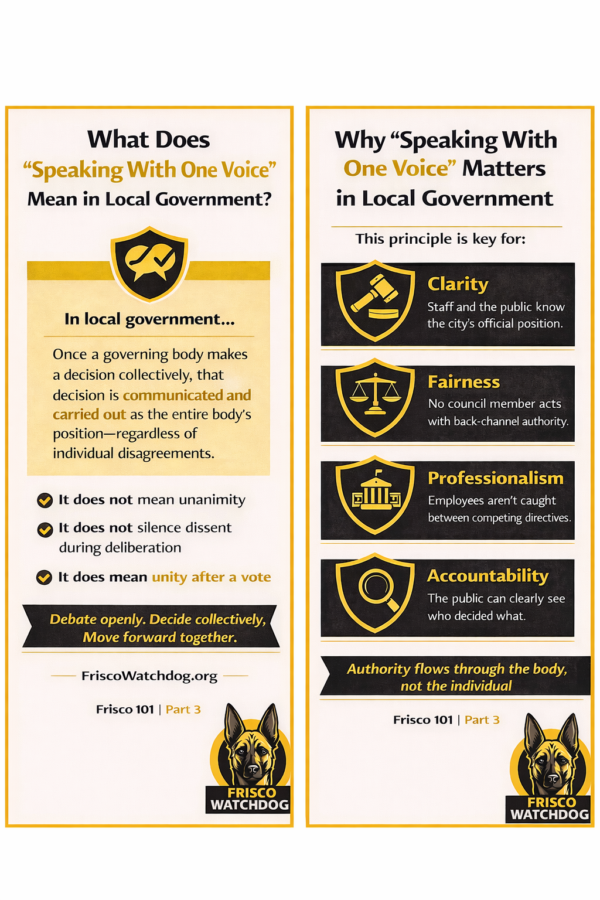
Speaking with One Voice
This is part 3 of my series on governance. Let’s talk about “Speaking with One Voice”.
When someone is on council, they have a couple of different hats they wear.
- As a candidate or individual with their own opinions. Be it on the campaign trail, or “On the dais.”
- As a member of the governing body and representative of the City.
It’s important to know the difference between those things. As an individual we expect someone to tell us where they stand on an issue. Be inquisitive, do research, form an opinion and make a decision. Don’t be wishy washy or straddle a fence.
As a member of the governing body a person is a representative of the body, of the City, and there comes a point where one must set aside the “self” and be a representative.
“Speaking with One Voice” is a governance best practice that guides how council members should approach the second item. Representing the City as a whole.
Attached to this article are 12 rules for elected officials. After 9 years in office, and 6 as an appointed board member, I find these particularly poignant.
The difference Between Governing and Campaigning
A governing body that “speaks with one voice” projects unity and fosters trust among its constituents. This unified communication is critical for effective governance, providing clear direction, enhancing credibility, and improving decision-making processes. When an organization’s leadership communicates a cohesive message, it reinforces confidence and minimizes confusion among the public, employees, and stakeholders. This does not mean they must all agree at all times. Rather, once a decision has been made it is important to effectively communicate the direction the organization has chosen.
Clarity and Direction
A consistent message eliminates ambiguity, ensuring that everyone understands the organization’s goals, policies, and decisions. Conflicting statements from different leaders can lead to misinterpretation, second-guessing, and a lack of clear direction. A unified voice acts as a single, cohesive source of truth, enabling constituents to act with confidence and alignment with the governing body’s objectives.
Enhanced Credibility and Trust
Credibility is the bedrock of effective leadership. When a governing body speaks with one voice, it demonstrates internal agreement and a shared commitment to its mandate. Disagreements aired publicly can create the perception of internal chaos or a lack of conviction, eroding public trust. A unified front reassures stakeholders that decisions are made through a thoughtful, collective process and are supported by the entire leadership team. The process is key. Once a fair and balanced process is established all members will have an opportunity for their input.
Streamlined Decision-Making
The process of speaking with one voice requires internal consensus-building, which can lead to more robust and thoroughly vetted decisions. By debating issues internally and then presenting a united front, the governing body ensures that various perspectives are considered before a final position is communicated. This internal deliberation strengthens policy outcomes and presents a united, formidable force to the outside world.
Crisis Management
In times of crisis, a governing body’s ability to communicate quickly, clearly, and consistently is paramount. A single, coordinated message can calm fears and provide necessary instructions. Multiple, potentially conflicting, voices during an emergency can exacerbate panic and hinder effective response efforts.
In summary, speaking with one voice is not about suppressing dissent, but about managing it internally and presenting a united, cohesive message externally. This practice is essential for maintaining order, building public trust, and effectively steering an organization toward its goals. Frisco has operated in this manner for decades through dozens if not hundreds of different council members and viewpoints. In recent months there seems to be a direction of some individuals to be disagreeable for the sake of being disagreeable. That’s not what Frisco needs, it’s not what its residents deserve.
It takes a lifetime to build a reputation, but it can be destroyed in an instant.