
Overview
Let’s talk some about governance. What does it mean? What does it not mean? What are the various roles in governance? This will be a multi-part series discussing governance. In this first part, you’ll get an overview of how our form of government works. In future parts, I’ll talk about what council members can and cannot do, the roles of boards and commissions, and how to speak with one voice. While some of this may be lengthy, I believe it is important to understand how things really work so, when you are listening to candidates tell you what they “will” do, you’ll have an understanding of what they “can” do.
First, what does “governance” mean in a Texas city-manager form of government?
When people hear the word governance, it can sound abstract or overly bureaucratic. But in local government, especially in Texas, it has a very practical meaning. Governance shapes who makes decisions, how those decisions are made, and how a city stays accountable to the people it serves.
In cities that operate under a city-manager form of government, like Frisco and most other Texas cities, governance is less about politics and more about stewardship, trust, and long-term community well-being.
Governance vs. management: A helpful distinction
One of the most important things to understand about governance in a city-manager system is that governance and management are intentionally separated.
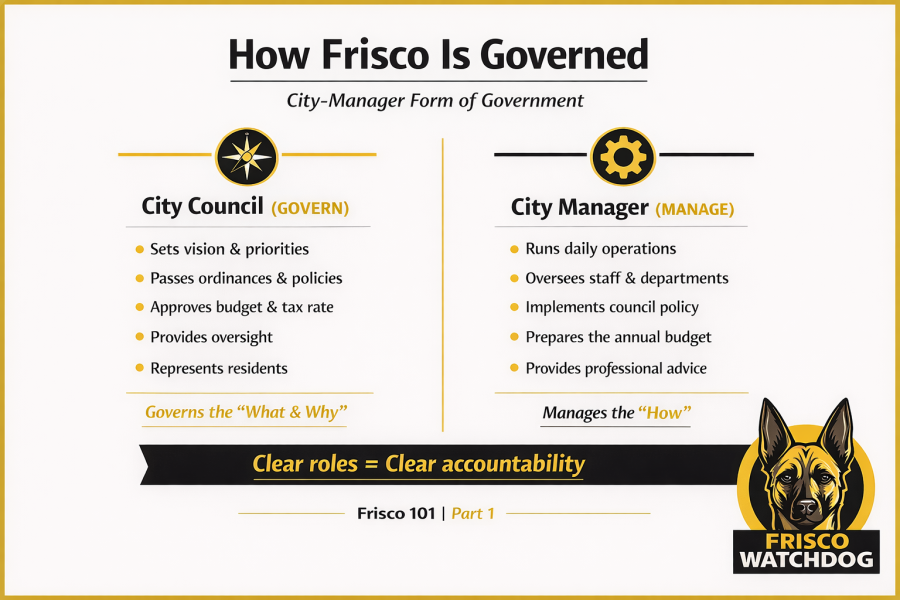
- Governance is the responsibility of the City Council.
- Management is the responsibility of the City Manager.
This separation helps ensure that policy decisions are made collectively and transparently, while daily operations are handled professionally and efficiently.
The role of the city council: Governing the “what” and the “why”
In Texas, cities with a city-manager form of government are governed by an elected city council, which may include a mayor selected by voters or chosen from among council members.
From a governance perspective, the council’s role includes:
- Setting the city’s vision, values, and priorities
- Establishing policies, ordinances, and resolutions
- Approving the budget and tax rate
- Representing the interests of residents
- Providing oversight and accountability
- Hiring the City Manager, and in Frisco’s case, the City Attorney and Municipal Judges
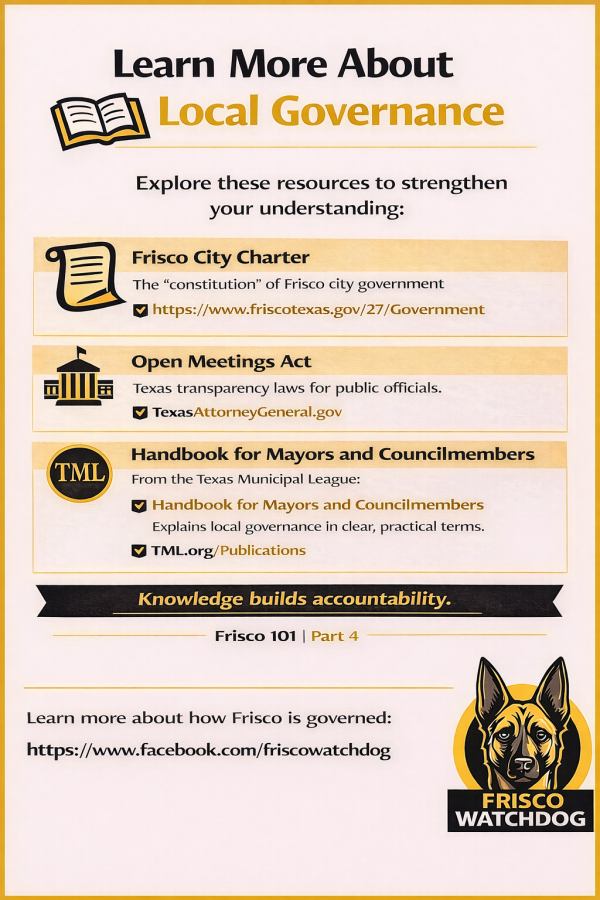
For a complete list of Frisco City Council powers, see Section 3.07 of the Frisco City Charter .
The council governs by asking:
- What kind of community do we want to be?
- What priorities best serve the public interest?
- How do we ensure fairness, transparency, and trust?
Importantly, council members do not manage staff or direct daily operations. That boundary is a cornerstone of effective governance.
The role of the city manager: Professional management in action
The city manager is hired by the city council to serve as the city’s chief administrative officer. While the council governs, the city manager manages.
From a governance standpoint, the city manager:
- Implements council-adopted policies
- Oversees city departments and staff
- Prepares the annual budget
- Provides professional, non-partisan advice to the council
- Ensures services are delivered efficiently and ethically
This professional management model, required by Texas law for city-manager governments, helps cities remain stable and effective regardless of election cycles.
Why governance matters at the local level
Good governance is not just about structure. It is about how power is exercised.
In a Texas city-manager form of government, effective governance:
- Promotes transparency and accountability
- Reduces politicization of city services
- Encourages ethical decision-making
- Supports long-term planning rather than short-term gains
- Builds public trust
When governance is working well, residents may not notice it, but they benefit from consistent services, responsible use of tax dollars, and decisions made with the whole community in mind.
Governance is a shared responsibility
While the city council has formal governing authority, governance does not happen in isolation.
Residents and business owners play a critical role by:
- Voting in local elections
- Attending council meetings
- Serving on boards and commissions
- Providing public input
Strong local governance depends on engaged constituents, informed elected officials, and professional management working together.
In simple terms
In a Texas city-manager form of government:
- The city council governs
- The city manager manages
- The community benefits from clear roles, professional administration, and accountable leadership
Governance is not just about rules. It is about responsibility, trust, and shaping the future of a city together.
Another resource is the Handbook for Mayors and Councils published by the Texas Municipal League.