
Roles and Responsibilities
This is the second part in my Governance series, let’s chat…
Before we get started let’s address the relationship between the City and the ISDs in our area. For reference there are 4 ISDs within City of Frisco limits (Frisco, Lewisville, Little Elm, and Prosper). Council Members have NO control over school board decisions or actions. Historically, the City staff, ISD staffs, Council and the Board of Trustees have worked closely with each other, but they are separate entities by design. If any candidate for council purports to influence or control the ISD they are either lying to you, or have no idea what the job they are running for entails.
What Frisco City Council Members Can and Cannot Do
The City Council is one of the most important bodies in Frisco’s local government. But what exactly can council members do, and what are they prohibited from doing? Understanding this not only helps residents stay informed, it helps keep local government accountable and accessible.
At the foundation are two legal pillars:
- Frisco’s Home Rule Charter: the city’s own governing “constitution,” and
- Texas state law (e.g., Local Government and Open Meetings Codes): which sets additional requirements and restrictions.
These legal pillars are further supported and reinforced by:
- Texas Municipal League (TML) Handbook for Mayors and Councilmembers: a statewide guide to municipal governance duties and limitations.
- Frisco’s Governance Policies and Procedures Guide: established and regulated by the city council, in partnership with the city attorney and city staff, and
- Frisco’s Code of Conduct : mandated by the Home Rule Charter.
1. The Role of the Council: Collective Authority
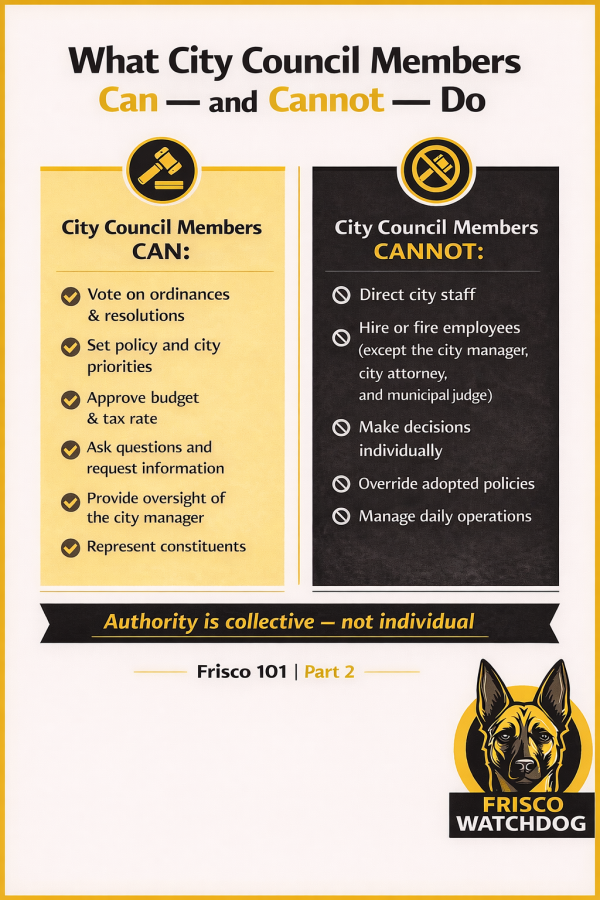
City Council powers belong to the collective body, not to individual council members acting alone. Frisco’s official government site emphasizes that authority lies with the council as a group to govern, and no single council member (including the mayor) can bind the city by individual action.
🧩What this means:
- Councilmembers can only act with other councilmembers through official votes or designated committee actions.
- A councilmember speaking alone cannot direct staff, set policy, or make commitments on behalf of the city. Part 3 of this series will discuss “Speaking with One Voice”
2. What Council Members Can Do
✅ Set City Policy
Frisco’s Charter says that all powers of the city and determination of policy are vested in the City Council,including ordinances, resolutions, and major decisions.
✅ Adopt the City Budget
Council approves the annual budget, which determines how tax dollars are spent.
✅ Appoint Key Officials
Council appoints and can remove:
- City Manager
- City Attorney
- Municipal Judges
- Other commissions as allowed by the Charter.
✅ Establish Boards and Commissions
Council creates planning, zoning, and advisory boards and appoints members.
✅ Conduct Investigations
Council has the power to investigate city departments, subpoena witnesses, and require records in official inquiries. In practice this is done through meetings and inquires with the City Manager and/or City Attorney.
✅ Modify the City’s Official Map and Plans
Council has authority over planning and redevelopment efforts.
✅ Launch Initiatives That Affect Voters
Under Frisco’s Charter (and common in home-rule cities), council can place issues on the ballot and respond to citizen petitions for initiatives, referendums, and recall. This process is highly technical and many times State Law will govern the process and language that is to be placed on the ballot.
3. What Council Members Cannot Do
❌ Unilateral Administrative Authority
Council members cannot,on their own, direct city staff or the city manager. Any interaction with staff must go through the city manager. Anecdotally, I learned this when I was first elected in 2016. I was the DORBA representative for the Mountain Bike Trail. I set up a meeting with the new Trail Steward and my staff contact. When I arrived, a senior member of the City Manager’s office was present. It was a first-hand learning experience that I was no longer just a citizen and there was protocol for any meeting with a staff member.
❌ Hold Other City Employment
Charter prohibits councilmembers (and the mayor) from holding paid city jobs while in office.
❌ Dictate Hiring & Firing
Council as a body may appoint or remove top officials, but individual members may not sabotage or interfere with the city manager’s staff decisions.
❌ Act Outside Official Meetings
Councilmembers can’t take official action outside of properly noticed and open public meetings (i.e., no back-room agreements or secret votes). This is reinforced by the TML Handbook’s emphasis on open meetings and transparency. The Open Meetings act also governs actions outside of meetings. While there are exemptions for a quorum of council to be present at social events council generally cannot meet outside of duly posted meetings.
❌ Override State or Federal Law
Even in home rule cities like Frisco (which have broad local powers), council actions must still comply with Texas statutes and the U.S. Constitution.
4. Key Limitations & Ethics
🛑 Conflict of Interest Rules
Frisco’s Charter has conflict of interest and abstention rules that prevent members from voting on matters where they have a personal interest.
🛑 Term Limits
Charter amendments establish limits on how long councilmembers and mayors can serve consecutively.
🛑 Public Transparency
Council meetings must follow open meetings requirements under Texas law, and records must be accessible.
Final Takeaways for Residents
📌 Council Members:
✔ Are policy makers who vote together to shape city direction.
✔ Appoint leadership, adopt laws, set the budget, and oversee policy.
🚫 They cannot:
✘ Control city staff individually.
✘ Use their title to make unilateral decisions.
✘ Violate open meeting laws or act outside statutory limits.
Understanding these boundaries helps citizens hold leaders accountable and engage more effectively in the civic process.
If you’re a resident of Frisco considering running for council or just want to follow local government more closely, knowing these rules is powerful knowledge for participating in democracy at the local level.